Fifty years have passed since Sean Connery appeared smoking a cigarette with his mocking "Bond, James Bond" in Dr. No. Countless lists have rated the subsequent movies with the usual suspects at the top and at the bottom. Here is one more.
If there is one thing that we can agree on is that no one agrees on what makes a good Bond movie. It, like everything else that is ranked according to what is "best," is subjective. James Bond is not Jason Bourne, John McClane, John Rambo, or any of other muscle men out there. He is a spy and Bond movies should be a spy movie with a taste of action.
My methodology looks at several factors: (1) plot, (2) villain/henchmen, (3) Bond girls, (4) acting, and (5) how is has held up over the years. A good plot is one that is able to be followed (not full of holes) and somewhat reasonable (not absurd). A good villain is one that engages Bond and has a diabolical plot that is somewhat reasonable (destruction of part of the planet v. destruction of the whole planet). A good Bond girl is one that is easy on the eyes and is an assistant to Bond (not one he just beds and moves on from). The marks of a bad Bond: absurd plot, unconvincing villain, and weak Bond girl.
I have ranked the movies in groups of five and not individually.
Explaining Some of the Choices:
In the First Five, I included some of the obvious choices of
From Russia With Love and
Dr. No. Perhaps it is too soon to add
Skyfall into the top five Bond movies but it does a wonderful job slowing things down and returning to the mystery/thriller vibe that is a hallmark of a spy movie.
Skyfall is in the top five for two reasons: the layered richness and Judy Dench. Finally, Dench gets to show what an amazing actress she is and rises to become a Bond girl on a different level.
Skyfall appears to have numerous allusions to previous movies such as: ex-MI6 villain (
Goldeneye), thrown knife in the back (
For Your Eyes Only /
Octopussy), personalized grip on gun (
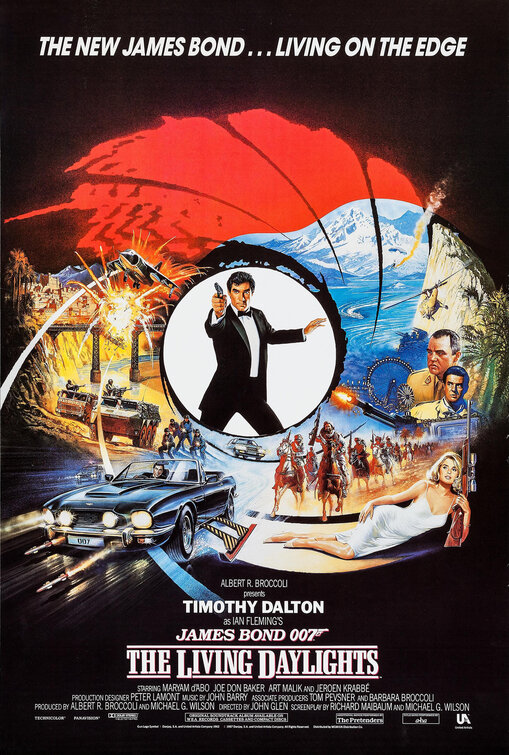
The Living Daylights), assault on manor home (
The Living Daylights), meeting assassin in Macau (
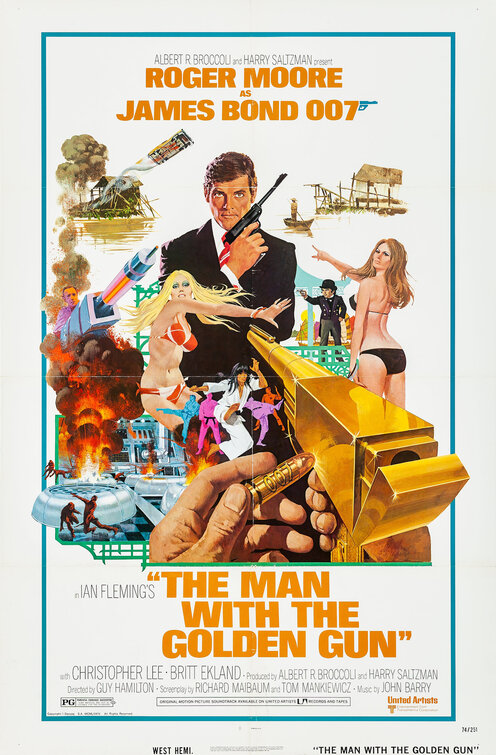
The Man With The Golden Gun), bombing at MI6/Vauxhall Cross/ tie adjustment (
The World Is Not Enough), and underground MI6 (
Die Another Day).
On Her Majesty's Secret Service is often misunderstood on the basis of George Lazenby's one-time performance (as are the Timothy Dalton movies). It offers such a wonderful exploration into Bond as a man and a test of his skills in such close proximity to his nemesis. We get to see Bond fall in love and then suffer loss.
Casino Royale does this nearly 40 years later, but
OHMSS did it first and everyone apparently forgot about it. The location in a secret ski resort is exotic but believable. While the movie does break the fourth wall and is a tad long, it is enjoyable to watch.
The Middle
The Second and Third Five all include movies I find to be strong Bond movies.
Goldeneye has a strong positive association for me and is an enjoyable movie. Too bad Brosnan did not have another outing as strong as this one. I enjoy
Tomorrow Never Dies, with the remote control 7 series and chase scene with the R1200C, but it just doesn't captivate you like some of the others. The villain becomes down right annoying as does the unkillable henchman.
The Living Daylights is a great Bond movie to me. I enjoy the Cold War intrique, Dalton's performance, the chase scenes and the Bond girl. I enjoy Dalton's departure from the Moore era's emphasis on cartoonish plots, double entendres, and corny humor. He gives Bond hard edges that are more fitting to the literary version.
Live And Let Die is another Bond with a positive association for me and is why I rate it higher than others. Yes, it has a tendency to be slow and the villain literally explodes. However, it sends Bond into a world he will never return to...New York City. (Bond returns to California and Florida in
A View to A Kill and
License to Kill, respectively.) It takes on some of the racial tensions of the era. It includes a great boat chase and one of the best, if not the best, theme songs by Sir Paul.
Quantum of Solace grows on me each time I watch it. It is a Bond for the ADHD and Jason Bourne (the movies) crowd. I don't know why they had to make it so jerky as there is a decent movie laying underneath. The vilain is compelling as he masterminds his way around Bond and contrives a truly sinister plot...drought. Finally, no one wants to blow up the world! The Bond girls are terrible and the oil scene with Ms. Fields is just a forced allusion to
Goldfinger.
The Fourth Five
The Man With The Golden Gun it has Christopher Lee has Francisco Scaramanga, who is a villain that
engages Bond on multiple levels. But it is so slow moving that I just can't rate it much higher. The solar energy tie in is dated and forced. Not to mention the reappearance of Sheriff J.W Pepper. Why is he on vacation in Asia? He should have stayed in Louisiana and in
Live and Let Die.
The last time I tried watching
You Only Live Twice I couldn't finish it. So what if it is Connery, it's a bore. Little Nelly is great and that is about it.
The World is Not Enough could arguable be one of the worst Bond movies (and is at least in the bottom five).
The World is Not Enough has a great opening sequence, character development of M, the last appearance of Q, and a comparatively reasonable plot. These traits, mostly the one about a reasonable plot, distinguish
The World is Not Enough above the bottom three.
The Bottom
It is easy to see that
Moonraker, with its absurd pseudo-
Star Wars money grab plot, is among the worst Bond movies. We are talking about a movie with a French villain who wants to poison the entire world from a space station that no one noticed he was building (and happens to be bigger than than thing
 |
| Moonraker (1979) |
anyone has ever built in space) and a Bond girl, who is a CIA agent/astronaut, with the name Holly Goodhead. Not to mention the existence of a bunch of space shuttles---with space lasers to boot. Aren't these things expensive? Weren't only five ever built? You can imagine the team sitting around with a scrip in hand and watching
Star Wars thinking "How can we turn this in to that?" One guy speaks up, "A space battle with lasers!" Another one says, "Yeah! That's awesome but what do the space ships look like?" The other guy says "The American space shuttle!" Another disappointment with
Moonraker is the appearance of Michael Lonsdale as Hugo Drax. Oh, what a waste of talent! We won't get to see this much wasted talent until
A View to A Kill (a movie that requires no explanation about how bad it is).
Moonraker's redeeming qualities are Jaws (pun intended), several excellent stunts (opening, cable car, and the zero gravity scene on the space station), and the best double entendre ("I think he is attempting reentry.").
In many respects
Die Another Day is the worst Bond movie. It has a decent opening sequence that shows Brosnan has acting talent, Halle Berry as a Bond girl, and one of the coolest Bond cars ever. Berry provides a fantastic update of the Honey Rider introduction scene but disappoints in nearly ever other way. This is not her fault but the fault of the bad movie all around her. The real problem with
Die Another Day comes down to the absurd plot: a North Korean who had gene therapy to look like a Western playboy, a satellite made out of diamonds (I saw that movie and it was called
Diamonds Are Forever), a robot arm thingy that controls the diamond/laser/satellite, an ice palace, a henchman named "Mr. Kill," and a plan to blow up the DMZ between the two Koreas. The over reliance on CGI makes the movie look dated just 10 years later. Let's not, or try, to forget Madonna is in this movie. The plot, presence of Madonna, and already dated feel pushes
Die Another Day to the bottom.
A View to A Kill ranks as the worst in terms of plot (create an earthquake to flood Silicon Valley, um okay), acting (Roger said he was about 400 years too old for the part. He was 57 and still too old.), and Bond girl (Grace Jones as May Day is about as flat and uninteresting as they come, not to mention those crazy outfits she ends up in.). Christopher Walken is a great villain and it is unfortunate he did not have a better movie to work with.
The List:
The First Five:
From Russia With Love
Dr. No
Casino Royale
On Her Majesty's Secret Service
Skyfall
The Second Five:
Goldeneye
Goldfinger
The Spy Who Loved Me
The Living Daylights
Live And Let Die
Third Five:
Thunderball
Licence To Kill
Diamonds Are Forever
Quantum of Solace
Tomorrow Never Dies
Fourth Five:
For Your Eyes Only
The Man With The Golden Gun
You Only Live Twice
Octopussy
The World is Not Enough
The Bottom:
Moonraker
Die Another Day
A View To A Kill

 This is a truly wonderful porter. As you can see from the picture, it has a rich dark color. It is a creamy delight with a hint of chocolate. Once you finish, you'll be reaching for another.